
How to Keep a High-Energy Dog Busy Indoors (Especially During Summer)
5 min read – House of Furs Editorial
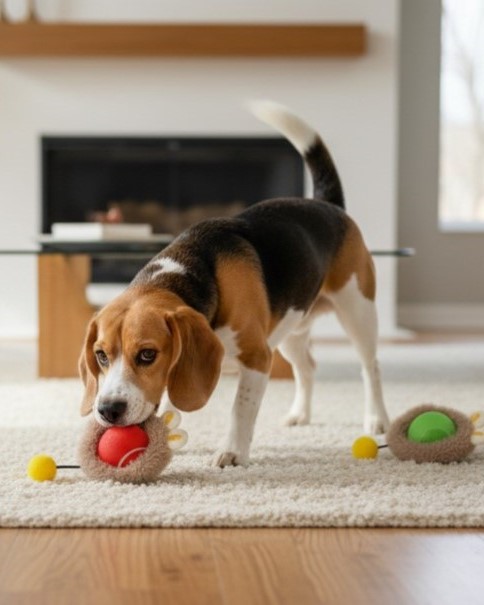
If your dog is still restless after walks, the problem isn’t time.
It’s stimulation.
And during Indian summers, when outdoor play becomes limited, this problem gets worse fast.
Signs your dog isn’t getting enough stimulation
If your dog is:
- tearing up paper, shoes, or furniture
- pacing around the house
- constantly demanding attention
- watching outside activity and getting restless
You’re not dealing with “bad behaviour.”
You’re dealing with unreleased energy.
Why walks are not enough for high-energy dogs
Most pet parents rely on walks.
But walks:
- are linear
- don’t fully engage chase instincts
- often end before your dog is actually tired
High energy dogs need repeatable engagement, not just movement.
This is exactly where an automatic ball launcher becomes useful.
Best ways to keep dogs busy indoors
To keep a dog busy indoors, you need systems, not one-off activities.
Here are the most effective ones:
1. Repetitive fetch (highest impact)
Fetch creates a loop:
run → retrieve → repeat
This is one of the fastest ways to burn energy.
But here’s the limitation:
You get tired. Your dog doesn’t.
This is exactly where most pet parents stop too early.
The smarter alternative
An automatic ball launcher for dogs removes that limitation completely.
It allows:
- continuous play without effort
- consistent energy release
- indoor use during extreme weather
Instead of throwing the ball 15–20 times…
You create a system where your dog can keep going.
This is one of the most effective ways to handle high energy dogs indoors.
2. Interactive toys (for mental stimulation)
Physical energy is only half the problem.
Dogs also need mental engagement.
Interactive toys:
- keep them occupied longer
- reduce boredom- driven destruction
- slow down their activity cycles
But these work best alongside physical play, not as a replacement.
3. Structured indoor exercise
Unstructured play leads to bursts of energy.
Structured systems release energy more efficiently.
This is why tools like:
- ball launchers
- controlled fetch systems
work better than random play sessions.
Why most indoor setups fail
Most homes rely on:
- occasional toys
- short play sessions
- inconsistent routines
That’s not enough for high energy dogs.
Without repetition and structure, energy builds up again quickly.
What actually changes behaviour
When your dog gets:
- repeated physical cycles
- consistent stimulation
- a daily outlet for energy
You’ll notice:
- less destructive behaviour
- calmer indoor presence
- reduced demand for attention
This is not training.
This is energy management.
If your dog still isn’t tired…
…it’s not because you didn’t try.
It’s because your current setup isn’t designed for repetition.
That’s the gap most pet parents miss.
Some tools are specifically designed to create repeatable exercise. Check our journal here to know more.
Indoor exercise solutions for dogs in summer
Instead of constantly trying to entertain your dog manually…
Use systems that do the work consistently.
At House of Furs, we focus on products that solve real behavioural problems, not just add toys.
If your dog is still restless indoors, especially during summer…
it may be time to upgrade how you handle their energy.
Explore the automatic ball launcher designed for consistent indoor and outdoor fetch.
FAQs
How do I keep my dog busy indoors all day?
Use a mix of repetitive physical activity (like fetch) and mental stimulation (interactive toys).
Why is my dog still hyper after walks?
Walks may not provide enough repetitive or mentally engaging activity for high-energy dogs.
What is the best indoor exercise for dogs in summer?
Fetch-based activities and structured play systems work well when outdoor time is limited.
Do dogs get bored at home easily?
Yes, especially if they don’t get enough stimulation or structured activity.